
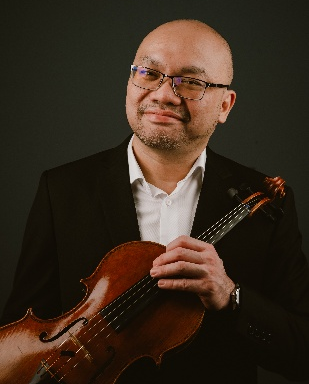
Senior Fellow of the Higher Education Academy of the United Kingdom
Bio:
Andrew Filmer is an associate professor at the Institute of Music, UCSI University in Malaysia, and a Senior Fellow of the Higher Education Academy of the United Kingdom. His research in the fields of music and education has been varied, encompassing explorations of bowed stringed instruments, acoustics, film music and reception studies, the intersection of composition and ethnomusicology, and the use of technology in education as well as in musical collaborative projects.
Andrew's research has been presented twice at Cambridge University, and he was a scholar-in-residence at Gonville & Caius College there, researching the intricate and varied history of violin and viola pedagogy. He was Editor of the Journal of the American Viola Society and is an advisor for the Australia and New Zealand Viola Society, and has presented at six International Viola Congresses. He has also been a guest speaker at the Monteverdi Conservatory in Italy, the National University of Singapore, the Royal Northern College of Music and the Royal Birmingham Conservatoire in the UK, the Elder Conservatorium in Australia, and the New Zealand School of Music.
Andrew is versatile in the arts, combining his musicology training with that of violin and viola performance and a passion for teaching. Andrew has won commendations and prizes in teaching, public speaking, research, music performance, and leadership.
Title: Technology’s Muse: Reimaginations of Technology from the Music Profession and the Music Classroom
Abstract: There are three arenas in which professional musicians and music educators utilize technological developments. One arena is that which they build exclusively for their craft, encompassing looping pedals, music notation software, and electronic instruments. A second arena is that in which musicians utilize existing technologies and extend them for discipline-specific purposes, such as advanced audio settings for Zoom meetings, or page-turning pedals for tablets when used to replace printed sheet music. The third arena utilizes the same technologies as in other fields, including everyday devices like mobile phones and tablets, but often in unique approaches towards music-making and music education. This presentation explores the second and third arenas, not only to highlight innovations within music performance and music education, but also to illustrate how novel reimaginations of technological tools can extend a sense of agency within student-centred learning at both tertiary and pre-tertiary levels.

Bio: Chung Kwan LO is an Associate Professor in Department of Mathematics and Information Technology & Academy for Education Development and Innovation at The Education University of Hong Kong. His primary research interests are technology-enhanced learning (e.g. flipped learning and AI in education) and mathematics education. He has published in various journals (e.g. Computers & Education, Smart Learning Environments, and Journal of Computer Assisted Learning). He has been recognised by Stanford University as one of the World’s Top 2% Most-cited Scientists since 2022.
Title: Using Generative AI to Support Values Education in Primary School Mathematics Teaching
Abstract: Mathematics lessons often focus narrowly on procedures and test performance, overlooking opportunities to support holistic student development by nurturing values and attitudes. In this presentation, we discuss how mathematical word problems are used as an entry point to create meaningful, real‑life contexts where values can be explicitly discussed in primary school mathematics lessons. Generative AI supports pre-service and in-service teachers by assisting in drafting diverse scenarios and generating associated pictures that reflect everyday events and acts. Our findings from lesson observations and written reflections indicate that students demonstrated deeper conceptual understanding and were better able to articulate concrete actions related to the values emphasised in class. Our teacher participants reported increased confidence and a stronger sense of feasibility in designing values‑embedded mathematical word problems. Key implications include the need for targeted teacher training related to AI-application skills and the accumulation of vetted AI-generated instructional materials for values education. Our next step is to enhance and trial a structured, AI‑powered values‑in‑mathematics platform with a wider group of pre-service and in-service teachers.

Hub for Language Education (HUB-Lit) Chair, Faculty of Education, University of Malaya
Bio: Associate Professor Dr. Chew Fong Peng obtained her PhD in the Malay Study from National University of Malaysia. She is the Hub for Language Education (HUB-Lit) Chair, Faculty of Education, University of Malaya (UM), Malaysia. She teaches Malay Language Education, Chinese Language Education, and early childhood education programs. She has presented approximately 200 working papers in international and international seminars and conferences in Malaysia and foreign countries, published 13 books, 184 articles published in journals, 77 papers in conference proceedings, 47 chapters in books, 25 translated books including creative writings, 14 edited books, and edited creative writings. She is the book editor of Taylor & Francis, editor for Malaysian Year 4, 5, and 6 History textbooks, and Year 1 Arts and Music Education textbooks. Assoc. Prof. Dr. Chew has completed 35 research projects, 13 of which being the lead researchers. She won numerous medals in the academy and innovative expo, besides being listed in Marquis Who's Who in the World 2011, 2012, 2014, 2015, 2017, 2018, 2019, and 2020. Chew is an article reviewer for established international journals on the Web of Science and Scopus, such as Frontiers in Psychology, Frontiers in Education, Asia-Pacific Education Researcher, Asia Pacific Journal of Education, SAGE Open, International Journal of Knowledge and Learning, Theory and Practice of Second Language Acquisition, Pertanika: Journal of Social Sciences and Humanities, GEMA Online, etc. Associate Professor Dr. Chew is also a member of the editorial board of many national and international journals including the Journal of Contemporary Educational Research, Review of Educational Theory, GATR Global Journal for Business & Social Science Review, and Advisory of International Research and Development Center for Publication (IRDCP). She was invited as a Visiting Professor at Peking University from October 2011 to June 2012, Sanming University from 2023 to 2025, and Zhengzhou Normal University from 2026 to 2031.
Title: Beyond Textbooks: Reimagining Malay Language Education in Chinese Higher Education
Abstract: This study examines the critical role, historical development, and current landscape of Malay language teaching and learning materials within China's higher education system. Driven by strategic initiatives and strengthened China–Malaysia bilateral relations, the number of Chinese higher education institutions offering Malay degree programs has expanded to 16. However, this quantitative growth has exposed critical qualitative deficiencies in available instructional resources. Current pedagogical frameworks suffer from significant resource gaps, particularly a scarcity of specialized materials for core language competencies such as listening comprehension and formal grammar. Furthermore, many existing textbooks are outdated, repetitive, or content-heavy, failing to differentiate between the distinct pedagogical goals of vocational, applied, and research-oriented academic tracks. To overcome these challenges, this speech advocates for a systematic reform of instructional material development. First, it proposes the establishment of a centralized oversight committee composed of academic experts and language practitioners to standardize curriculum guidelines, ensure quality control, and maintain contemporary cultural and linguistic relevance. Second, it calls for an iterative development process anchored in rigorous needs analysis, collaborative textbook design, and periodic empirical evaluation. By systematically aligning pedagogical resources with the evolving demands of the global workplace, Chinese universities can cultivate highly proficient, culturally agile Malay language graduates capable of contributing meaningfully to international diplomacy, trade, and cross-cultural exchange.
Keywords: Malay Language Pedagogy, Instructional Materials, Higher Education in China, Curriculum Standardization

Bio: Dr. Nurul Farhana Jumaat is an Associate Professor in the Faculty of Educational Sciences and Technology at Universiti Teknologi Malaysia, with expertise in Educational Technology. Her research focuses on online learning design, instructional strategies in online learning and AI in education. In addition to her active research and postgraduate supervision, she serves as an Editor for the Malaysian Journal of Social Sciences and Humanities and the Innovative Teaching and Learning Journal, contributing to the quality and dissemination of educational research. Dr Nurul Farhana is also actively involved as a researcher and member of in international collaborative projects, including ICTeEfS, which focuses on the research related to the use of ICT in education and teacher professional development, and the DX.SEA Erasmus+ Capacity Building in Higher Education (CBHE) project, which supports digital transformation, online learning innovation, and capacity building in higher education across Southeast Asia.
Title: Integrating Generative AI (GenAI) into Problem-Based Learning to Enhance Students’ Self- Perceived Problem-Solving Ability in Embedded Systems Course
Abstract: The increasing adoption of Generative Artificial Intelligence (GenAI) in higher education has transformed the way students access information and engage in learning. While GenAI offers significant potential to support learning, concerns have emerged regarding students' overreliance on AI-generated responses, which may hinder the development of confidence in solving authentic engineering problems independently. These concerns are particularly relevant in Embedded Systems courses, where students are expected to analyse complex problems, evaluate alternative solutions, and apply theoretical knowledge in real-world contexts. Problem-Based Learning (PBL) has been widely recognised as an effective instructional approach for fostering problem-solving; however, limited empirical evidence exists on how GenAI can be systematically integrated into PBL to enhance this outcome. Our study aims to design GenAI-integrated PBL approach and examine the effectiveness of a GenAI-integrated PBL approach in enhancing students' self-perceived problem-solving ability for Embedded Systems courses. The findings will inform the development of a pedagogically grounded GenAI-integrated PBL approach that supports educators in designing meaningful AI enhanced learning experiences, contributes to the advancement of instructional design research, and promotes the responsible integration of GenAI to strengthen students鈥?problem-solving abilities in learning.
Keywords:
Malay Language Pedagogy, Instructional Materials, Higher Education in
China, Curriculum Standardization
© The 2026 12th International Conference on Learning and Teaching (ICLT 2026)